Monday, April 11, 2016

Sunday, April 10, 2016
Cave Girl
For Module 11, I went to The Digital Comic Museum and read the comic "Cave Girl" Issue #12. In this issue, Cave Girl, an archaeologist, had her work disrupted when a group of skull heads attack her and fellow archaeologist, Luke. Using clubs and rocks Cave Girl defeats the group of skull heads, leading a female to save the campsite.
Though it is refreshing to see a female singlehandedly take the lead, the comic reverts back to sexism almost immediately. By first look, this "hero" is seen in a short zebra dress, and of course as very large "curves", along with a huge pink flower in her hair - to further emphasize it is a female lead. But the sexism doesn't stop with just the looks. On the first page, Cave Girl is seen thanking her partner, Luke, and attributing her knowledge to him, as if she could not complete her job without him. In fact, it wasn't until Luke was hurt that Cave Girl got the "strength" to save the day, and there was disbelief in the village after she took down a group of skull heads to save the day.
Even in a comic where a female is the lead there is the connotation that a girl must rely on the man for her brains, and must be in love with her male partner. And aside from the looks and love, there is also lust being shoved down the readers throat. Cave Girl's sexuality is seen from the beginning, all the way to the end, which forces us to believe the writer is using her as a sexual object, rather than believing a strong women can save the day.
Thursday, April 7, 2016
Glamorous Romances
 For this blog post I entered The Internet Archive Comics
Collection to broaden my horizons and dive into some comics. I’ve never really
been a Comic kind of girl but after looking through a lot of comics they’re
actually very entertaining. Being a woman who loves the thought of romance, I
found a comic titled Honeymoon For One located
in the Glamorous Romances comic book in
the December issue. The comic focuses
on a couple by the names of Rita Burton and Julian Doyle. The couple met at the
Museum of science where they fell madly in love. They plan on getting married
and having a honeymoon in Tahiti (the museum is doing a exhibition on Tahiti and
Julian needs to go collect materials there) all is good until Rita catches
Julian kissing another women, his Ex Fiancé. Julian resigns and leaves with his
former fiancé. Rita still plans on going to Tahiti and her boss assigns an
assistant to go with her named Gibbs Smith. Rita and Gibbs get swept up in the
romance of the island and end up falling in love in Tahiti. Not shortly after
but who appears, Julian, confessing that he still loved Rita and their love
becomes one big triangle between Gibbs, Rita, and Julian. In the end Rita goes
with her heart and actually decides to marry Gibbs and they live happily ever
after. I believe we can look at this comic through a feminist theoretical lens. Honeymoon For One shows feminism in a positive light. When Julian
resigned from the Museum and ran off with his ex Fiancé, instead of giving it
to another leading male, they gave Rita the responsibility to go to Tahiti
herself and finish the exhibit. Women fight for equality between men and women,
especially in the workforce.
To Read Honeymoon For One click below:
https://archive.org/details/glamorous-romances-072
Monday, April 4, 2016
Module 11 Example: Reading Comics
PROMPT
EXAMPLE
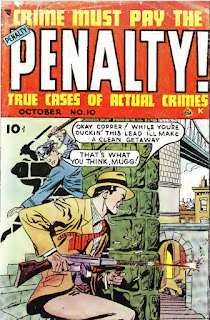
For this module, I will be tackling Crime Must Pay The Penalty Issue #10 from October, 1949. The comic contains 4 comic stories (Revenge of the Cop Haters, The Genius and the Perfect Crime, Sinister Cab Combine, Pledged to Homocide), and one text story (Lineup Masquerade). Revenge of the Cop Haters and Pledged to Homicide both entail prisoners who get out of prison and continue to commit crimes in attempt to get the aforementioned revenge or just to cause chaos. The Genius and the Perfect Crime and Sinister Cab Combine, both deal with people who are aspiring improve their social standing (one to become part of elite culture and the other to court a woman) and commit criminal acts to achieve them. Given the history of comics and the interest in crime comics (and eventually, horror comics) that we talk about in this module, I think discussing hegemony is probably a good topic to consider. In hegemony, we see that there is a disruption of culture or an intrusion and that society tries to use compromises of sorts to limit actual substantive change. Many of the comics read are often by youth, who feel disempower and crave a life not confined by rules and order. Crime stories provide this opportunity to explore the uninhibited life. Readers get to enjoy vicariously, the adventures and violence by the criminals represented in these tales. However, the compromise comes with the fact that the stories often ended in their demise. Thus, the cultural hegemonic powers provided the exploration of power in the face of authority but only tangentially and always with a message that this path ends in destruction of the individual instead of the overarching authority.
For this post, students should visit either the Digital Comic Museum or The Internet Archive Comics Collection and read a US-based comic (these archives have manga and other non-US comics; these are not acceptable contributions for this assignment). After reading the comic, provide an analysis of the comic using one or more of the theoretical lenses that have been presented to you in the course lectures such as feminism, race & ethnicity studies, the Frankfurt School (also known as critical inquiry; also, don't forget Part 2 & Part 3), symbolism, post-modernism, and hegemony.
Your post should include the following:
- A clear identification of the comic book that you read that includes the title, issue number, and direct link.
- Describe the content (1 paragraph).
- A brief discussion of a theoretical lens that you want to use (1 paragraph).
- Applying the theoretical lens to the comic to explain what newer meaning is derived by using the lens on the comic (1 paragraph).
EXAMPLE

For this module, I will be tackling Crime Must Pay The Penalty Issue #10 from October, 1949. The comic contains 4 comic stories (Revenge of the Cop Haters, The Genius and the Perfect Crime, Sinister Cab Combine, Pledged to Homocide), and one text story (Lineup Masquerade). Revenge of the Cop Haters and Pledged to Homicide both entail prisoners who get out of prison and continue to commit crimes in attempt to get the aforementioned revenge or just to cause chaos. The Genius and the Perfect Crime and Sinister Cab Combine, both deal with people who are aspiring improve their social standing (one to become part of elite culture and the other to court a woman) and commit criminal acts to achieve them. Given the history of comics and the interest in crime comics (and eventually, horror comics) that we talk about in this module, I think discussing hegemony is probably a good topic to consider. In hegemony, we see that there is a disruption of culture or an intrusion and that society tries to use compromises of sorts to limit actual substantive change. Many of the comics read are often by youth, who feel disempower and crave a life not confined by rules and order. Crime stories provide this opportunity to explore the uninhibited life. Readers get to enjoy vicariously, the adventures and violence by the criminals represented in these tales. However, the compromise comes with the fact that the stories often ended in their demise. Thus, the cultural hegemonic powers provided the exploration of power in the face of authority but only tangentially and always with a message that this path ends in destruction of the individual instead of the overarching authority.
The Office is postmodern, from tv to online
I watched the video Postmodernism and The Office which talks about how the office is a good example of postmodernism by being a mockumentary, making popular culture references and having its online presence authentic as if it were a real entity.
First off the format of the office mocks that of a documentary, from the shaky one camera shots that follow the character around, to the close up interviews, the way the office is shot reflects the style of many documentaries. Other such things that do this would be Reno 911 or Borat, which both satire their subjects, providing a social commentary along with comedy.
The office makes many popular culture references throughout the show, from the characters referencing their knowledge on Battlestar Galactica or The Lord of the Rings, or even mentioning that they caught the last episode of the Apprentice, the characters try to prove that they are real people by being relatable and like most people, they discuss tv, movies and other pop culture things.
And lastly the Office website. This internet masterpiece includes blog sites for each of the characters along with photos and episode guides. There even is a mock website for the Dunder Miflin paper company that was updated along with the progression of the show. This site is a delight to viewers who wish to experience the office in other forms of media as well.
The Office is very postmodern in that it is a work of fiction that pulls from real life to give itself an authentic feel. With its website and the documentary format it attempts to establish itself as a pseudo real identity never giving up its guise of authenticity. This proves for a very entertaining and unique take upon life in the office and makes a great postmodern show. Quite a few other shows or films also attempt to create something that seems real to make a point, for example District 9 is an allegory about racism and apartheid but uses Aliens as the persecuted race to make its point. It is also another mockumentray but it comes with an important message.
Sunday, April 3, 2016
Post Modernism Explained, Sort of
https://www.youtube.com/user/UnboringLearning
This video is very entertaining. He tries to explain post modernism by telling us its unexplainable, or at least complicated. He has great facial expressions and uses dramatic pauses well and his sense of timing is awesome. Basically it boils down to the fact that post modernism started somewhere around the mid 19th century. Evidently, nobody agrees on when it started and what it is. I guess if I had to explain it, I would categorize it as being beyond the modern times. Since this society lives so much in the future in a lot of books and movies, it can include, well, now. I kind of think about how some sci-fi movies sort of come true in our society. For instance, My Dad told me when he was young, he would go to the movies and watch Flash Gordon go to the moon. It hadn't happened in real life until he was in his 20's. So to him, he Flash Gordon series was almost reading the future. I remember when the original Star Wars came out, lasers and computers were just for the scientific community, the movie implied that everybody would have access to this technology for everyday life. At that time, none of us believed that would be true in our own lifetime, but look at us know. Maybe we don't have robots doing our work or have to face the Dark side of the Force on a daily basis, but we certainly cannot live without our cell phones and computers. So if you want to know what the future will bring, keep a close eye on the current sci-fi movies and if you are ambitious enough, maybe you can make the next step in the world of technology yourself.
Postmodernism in Bob's Burgers
Firstly, the shows youngest child, Louise, wears a pink rabbit ear hat at all times (the only exception being one episode, where she loses her ears and spends the episode finding them). She even attends school while wearing the ears, and is almost never asked to remove them, and nobody questions why she wears them. This is a great example of what the (non-Office) Postmodernism video mentioned about how truth can have many different meanings. Louise wears her ears because she feels it's normal and right, even though nobody else is wearing them in the show.
Tarantino's Penchant for Pastiche
One of the contenders for this year's Best Picture Oscar was Quentin Tarantino's epic film The Hateful Eight. In true Tarantino form, this is a delightfully violent, and colossal who-dun-it that also happens to rely heavily upon pastiche*. Quentin Tarantino has done this masterfully with his allusions to the popular Bruce Lee martial arts movies, using David Carradine in Kill Bill Vol 1 & 2, and to Blaxpoitives with Pulp Fiction. Tarantino has, on many occasions, admitted that he steals from every movie he has ever watched and yet his directorial style somehow twists each homage into something uniquely his own.
The Hateful Eight incorporates elements reminiscent to both Leonard Elmore's popular Raylan Givens westerns and to Agatha Christie's classic mysteries featuring Hercule Poirot. Yet this Jacobean whodunit, set in the aftermath of the Confederate War with Tarantino fav's Tim Roth, Walton Goggins, and Samuel L Jackson, could have just as easily been set in a Victorian manor, with Tarantino choosing to set this in the wild west of Wyoming. It is this blending of genres that gives fans of each genre--the western and the murder mystery--a refreshing experience since the traditional formulae are abandoned.

The Hateful Eight tells the story of eight principal characters, all strangers to each other who seek refuge in Millie's Haberdashery as a blizzard moves through the wilds of Wyoming. All eight characters clearly have a past filled with violence, and it is this violence, and the threat of violence that in actuality acts as the authority figure exercising control over this group. And true to form, Tarantino judiciously punctuates the film with gratuitous displays of the violence for which he is renown.
Story aside, this movie is a perfect example of a current popular film that employs pastiche as a story telling device. At first glance it is evident there are many of the trademark western trappings: the Sheriff--Chris Mannix (Walton Goggins), the outlaw**--Daisy Domergue (Jennifer Jason Leigh), the bounty men--John Ruth (Kurt Russel) and Major Marquis Warren (Samuel L. Jackson), a stagecoach, and the majestic and threatening frontier itself. However Tarantino abandons the traditional good guy vs bag guy Cowboys and Indians and presents his audience with only the "bad guys/gal", any of which are capable of arousing the audience's sympathies.
However, if this is a true example of pastiche, where does the second element lie? Tarantino weaves the Agatha Christie'esque story line into his wintry western setting, creating a meandering plot for the characters to navigate.
First, we have an ever growing circle of strangers thrust together by the elements and among this circle of strangers there is a killer lying in wait much like Christie's And Then There Were None--also published under the names Ten Little Indians and Ten Little N------s ( curiously, an epithet used liberally throughout The Hateful Eight). How do we know the killer is lying in wait? It would not be a Tarantino film without glorified and frivolous carnage. And as the story progresses, we see the careful deductions: who has the means and motive, and who is Domergue's accomplice?

During the film, one of Domergue's accomplices slips poison into the coffee to murder, in graphic style, her intended victim but without care for who may or may not consume the toxin. Likewise, Christie was notorious for employing poison as her tool for murder. Novels that come to mind are Curtain and Five Little Pigs--riffing again on the use of a number in the title--in which Christie offs her victims with poison.
Now it becomes evident that Domergue has more than one accomplice and this meshes nicely with Murder on the Orient Express, where our hero Poirot comes to recognize that every person on the the train has reason to want the victim dead but unlike Poirot's suspects, Domergue and her fellow conspirators are not granted immunity for their murderous past.

And finally, as I mentioned earlier, Tarantino plays with numbers in the title The Hateful Eight, or more specifically the use of a number in the title. The Hateful Eight calls to mind The Magnificent Seven but is more likely a double down on the title The Big Four in which a minor character by the name of Dr. Quentin claims to be an admirer of Poirot, just as Tarantino quite evidently appears to be an admirer of Agatha Christie with his latest blockbuster.
We are left then with another classic black comedy from Tarantino, cleverly peppered with pop culture references, filled with violent tension, and fabulous dialogue all set primarily in one room. Tarantino reworks these two genres, appropriating elements from each into what is now a recognizable style of his own, and true to form Tarantino ends it all with a fabulous Fuck Yeah! bloodbath in the end.
*Pastiche, a popular post modernism literary device that is not parody, but is instead a borrowing or blending of ideas into a collage that gives tribute to any given genre.
** Intriguingly, Tarantino twists that up too, using a female for his baddy which due to the violence caused some uproar, resulting in some describing Tarantino as a misogynist.
Post Modernism in Advertisements
Post modernism is all about the way answer questions we have for the world. As the video explains, at the beginning of time the people turned to the church for the truth, as God was all knowing, therefor knew all the answers. As time went on, and technology advanced, people turned to the printing press and newspapers for the truth. When the Scientific Revolution went on people relied on logic, reason, and of course science for the answers to all their questions. However, these scientific advances has failed us because humans have changed the outcome to these answers. Because these scientific advances has left us with an unclear meaning, we are left with post modernism - which is simply us searching for answers. This is where advertising comes in to play off our lack of clear meaning in the world. Ads are commonly leaving us with more questions than they answer, which is the key problem in a post modern world.

Many ads today follow the same type of logic described in the video. Take this Abercrombie & Fitch ad (or really any A&F ad). There are 3 guys, shirtless in what looks to be a great conversation. That's great, but what is this ad supposed to be selling? Isn't Abercrombie a clothing store? They make cologne, too, but there's not description of that either. Instead the company has left us to want their products simply off the looks of these young men. Even though the companies logo is attached to the picture it falls under the post modernism category because it leaves us with more questions about the company and their products than what we had before hand.Po
Postmodernism and Our Sense of Reality
Facts, according to Postmodernism: Social and Cultural Ideals,
are not absolute but something to be interpreted. Our sense of reality has
changed as we can manufacture our identities in order to present to the world
what we want others to see, though personality tests purportedly allow us to
find out who we really are. Attaching meaning to things is impossible as there
are no absolutes. One image that floated by during the video caught my eye. It
was of art installation outside Marfa, Texas which I visited on a road trip a couple years ago. Along a desolate highway in the middle
of the desert there is a Prada “store”.


If somebody that wasn’t expecting to
see this they would question reality and whether or not the “store” was real.
It is immaculately kept with shoes displayed in the windows so it seems
plausible that you could actually shop there. It is, in fact, just an obscure
art installation. Others ways in which reality can be distorted is through
technology. Instagram and other social media sites allow users to create a
personality for themselves which may or may not represent reality. Photo filters
have the ability to make a somewhat sunny day seems brighter than it is. Setting
up the perfectly cropped shot also distorts reality as, Chompoo Baritone,
shows in her The Truth Behind Instagram Series.

Subscribe to:
Posts (Atom)