Showing posts with label sexism. Show all posts

Wednesday, March 1, 2017

Strategic Butt Coverings!

That's right, you read correctly. Butt coverings. This is the controversial topic covered in Feminist Frenquency's video from the overarching topic of Tropes vs Women in Video Games.


Oh look! There's Laura Croft in the very first example, just as I mentioned in my discussion post about how the game takes place in third person view, where the player's eye is drawn to her meticulously crafted behind. What's the problem with this? Well, there wouldn't be so much outrage over it if in contrast the same design strategy was used for male characters - except it isn't. Similarly, I want to add that the first ever game where Lara Croft appeared is incessantly mocked - even by fans - because of her hilariously awful character model. Here, the game designers basically said through the design: "It doesn't matter if her boobs look super bad, as long as she has boobs for the boys to look at" and it's completely and utterly ridiculous to place that much emphasis on having that be a feature when they couldn't even animate it properly. In hindsight they should have just had her mildly endowed or even flat chested, but no - it was more important that she have ice cream cone-shaped breasts than none at all.

Atrocious. Found in an awesome article of the evolution of her character over time (source).
In contrast, along with the many other challenges facing people like myself - female gamers - we face the reality that male video game characters are not treated with such injustice. Which actually kind of sucks because I would love to get a clear glimpse at Ezio Auditore or Soldier 76's ass! I had not guessed that the title of the video would actually refer to the men of video games, who are explained in the video as having an excuse to not have their butts shown because the game creators want the people (read: men) to identify with those characters. But the women? Nope, just there to be eye candy, maybe move the plot along a bit at times.

I think its high time we take a closer look at the demographics of game consumers and also at the way we are portraying gender and sex in video games. The game industry would love to believe that it's just young straight men who play their games, and secondarily that they play them either to relate to a male character or want to stare at a sexy female. I can only name a handful of times that I've gone to a video game store and not been asked if I was buying the game for my boyfriend or brother. No! I'm buying the game for ME! By the way, when the next Assassin's Creed game comes out, can I get a lingerie skin for the male protagonist if I preorder the gold edition? Pretty please!

Now that's what I'm talkin' about! Ezio Auditore from Assassin's Creed II by DoubleLeaf on DeviantArt.
Either everybody should have their junk hanging out for people to enjoy - or everybody should be covered properly. This trope doesn't even begin to cover my gripes with parts of the cosplay industry - whereby a lot of "popular" female cosplayers usually wear lingerie or bikini or sexy versions of armor or of regular characters. Sometimes they even cosplay a "sexy female" version of an original male character that wasn't ever sexualized at all! I'm never sure whether to be annoyed at these people, or just enjoy their creativity. I may never know which side I stand on. I just want to see more dude butts.


Sunday, April 10, 2016

Cave Girl

For Module 11, I went to The Digital Comic Museum and read the comic  "Cave Girl" Issue #12. In this issue, Cave Girl, an archaeologist, had her work disrupted when a group of skull heads attack her and fellow archaeologist, Luke. Using clubs and rocks Cave Girl defeats the group of skull heads, leading a female to save the campsite.

Though it is refreshing to see a female singlehandedly take the lead, the comic reverts back to sexism almost immediately. By first look, this "hero" is seen in a short zebra dress, and of course as very large "curves", along with a huge pink flower in her hair - to further emphasize it is a female lead. But the sexism doesn't stop with just the looks.  On the first page, Cave Girl is seen thanking her partner, Luke, and attributing her knowledge to him, as if she could not complete her job without him. In fact, it wasn't until Luke was hurt that Cave Girl got the "strength" to save the day, and there was disbelief in the village after she took down a group of skull heads to save the day.

Even in a comic where a female is the lead there is the connotation that a girl must rely on the man for her brains, and must be in love with her male partner. And aside from the looks and love, there is also lust being shoved down the readers throat. Cave Girl's sexuality is seen from the beginning, all the way to the end, which forces us to believe the writer is using her as a sexual object, rather than believing a strong women can save the day.

Sunday, February 28, 2016

The Ms. Male Character and other Female Gaming Characters

Anita Sarkeesian, host of
Feminist Frequency (Image Source)
The video I watched this week was Ms. Male Character - Tropes Vs. Women in Video Games. In the video, Anita Sarkeesian speaks about the concept of a "Ms. Male Character" and how often they appear in video games. This concept came about due to a need for female characters in games, but these specific types of female characters are essentially female stereotyped clones of their male counterparts. In gaming, this began with Ms. Pac-Man, who is basically just Pac-Man with a bow, eyelashes, and lipstick. All of these things are what people identify as female, but Anita points out that these are things that are completely superficial, created by society.
There are examples of female characters in games that don't fall into the Ms. Male Character trope, such as Claire from Thomas was Alone (see left) and Ellie from The Last of Us, but unfortunately, most female characters will end up being created using this exact trope. This trope also tends to mean the characters have very little depth or personality, outside of being a female version of their male counterpart, like Ms. Pac-Man.

Claire from Thomas Was Alone (Image Source)
As an avid gamer, this makes me think a lot about what makes a female character in a game. Is it for the sake of having a female character? How were they created? Why are they dressed the way they are? I then realized that some of my favorite female game characters avoid these tropes, at least mostly. A recent favorite of mine was Lara Croft in my personal Game of The Year 2015 pick, Rise of The Tomb Raider. Lara is the central character, and has no male counterpart. She doesn't display many of the stereotypical female attributes, and in fact displays herself as one of the most bad ass characters around, male or female. She's tough as nails, doesn't wear pink, but she does have a bow. Only this one isn't the kind you stick in your hair. This is a total change from her original character's portrayal, who was a hypersexualized woman with large (albeit polygonal) breasts and long legs. The new Lara, which was changed for the 2013 reboot of the Tomb Raider series, removes this hypersexuality, going for a far more subtle look.

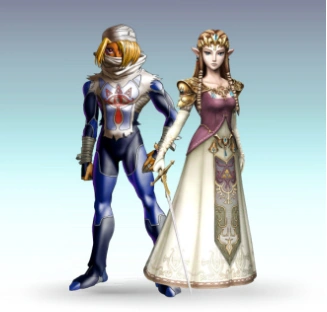
Zelda and her disguised persona, Sheik (Image Source)
Princess Zelda of The Legend of Zelda fame allows us to take an interesting look at this trope. Zelda herself, while not a "Ms. Male Character", does have some of the stereotypical female attributes. She has long hair, wears purple, and has a tiara. However, in one of the greatest games of all time, The Legend of Zelda: Ocarina of Time, she disguises herself as another character named Sheik, who displays none of the female stereotypes we're used to seeing in games and pop culture in general.

It's important to look at female characters in gaming and understand where they come from. I believe more of an effort needs to be made in order to change the Ms. Male Character stereotype, but we seem to be well on our way, especially thanks to characters like Lara Croft in the Tomb Raider reboot.

Saturday, February 27, 2016

Toy Ads and Sexism


        In this video, uploaded in November 2010, the topic of TV ads for toys are gender biased. In the clips we see boys toys as promoting a tough exterior, a strong reference of power and control, and an emphasis on competition. When we watch the ads for the girl toys we see a far different story: the homemaker, "mother", an emphasis on beauty, and everything sparkles and glitter. She even gives the example of a gender neutral toy "Moon Sand" and two very different ads for the same product. In the ad where boys are playing with Moon Sand, they are playing with tractors and how the sand can be built or smashed, leading the boy to a "masculine" job. When we see the ad for the girls the same product can be used "to decorate!" Overall, the video explains that these ads are a bad example for children. From a young age the boys are learning that they are the more prominent and dominant gender who can go on to any strong career, while the girls are being told they must be pretty and stay at home to cook, clean, and take care of the children.

         I really enjoyed this video because it explains the main problem with the sexism in advertising, which is it's influence on children. Of course girls will grow up thinking they are week if they are handed the toy broom and Easy Bake Oven, while the boy is allowed to play with guns and racing toys. The problem of sexism is starting at an early age because this is the idea that we are being taught from the beginning. Of course, this could all be different in the homes of each child. I know personally that more parents now are allowing their children to make the decision on what toys they want to play with, gender aside. But this only works so much, because the media will continue to portray men as strong and women as weak, which isn't a very powerful statement for little girls to see and hear.