Showing posts with label Crime Must Pay the Penalty. Show all posts
Showing posts with label Crime Must Pay the Penalty. Show all posts
Monday, April 11, 2016

Monday, April 4, 2016
Module 11 Example: Reading Comics
PROMPT
EXAMPLE
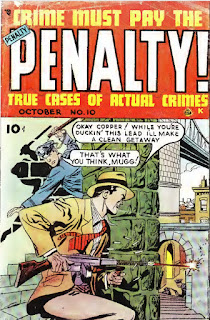
For this module, I will be tackling Crime Must Pay The Penalty Issue #10 from October, 1949. The comic contains 4 comic stories (Revenge of the Cop Haters, The Genius and the Perfect Crime, Sinister Cab Combine, Pledged to Homocide), and one text story (Lineup Masquerade). Revenge of the Cop Haters and Pledged to Homicide both entail prisoners who get out of prison and continue to commit crimes in attempt to get the aforementioned revenge or just to cause chaos. The Genius and the Perfect Crime and Sinister Cab Combine, both deal with people who are aspiring improve their social standing (one to become part of elite culture and the other to court a woman) and commit criminal acts to achieve them. Given the history of comics and the interest in crime comics (and eventually, horror comics) that we talk about in this module, I think discussing hegemony is probably a good topic to consider. In hegemony, we see that there is a disruption of culture or an intrusion and that society tries to use compromises of sorts to limit actual substantive change. Many of the comics read are often by youth, who feel disempower and crave a life not confined by rules and order. Crime stories provide this opportunity to explore the uninhibited life. Readers get to enjoy vicariously, the adventures and violence by the criminals represented in these tales. However, the compromise comes with the fact that the stories often ended in their demise. Thus, the cultural hegemonic powers provided the exploration of power in the face of authority but only tangentially and always with a message that this path ends in destruction of the individual instead of the overarching authority.
For this post, students should visit either the Digital Comic Museum or The Internet Archive Comics Collection and read a US-based comic (these archives have manga and other non-US comics; these are not acceptable contributions for this assignment). After reading the comic, provide an analysis of the comic using one or more of the theoretical lenses that have been presented to you in the course lectures such as feminism, race & ethnicity studies, the Frankfurt School (also known as critical inquiry; also, don't forget Part 2 & Part 3), symbolism, post-modernism, and hegemony.
Your post should include the following:
- A clear identification of the comic book that you read that includes the title, issue number, and direct link.
- Describe the content (1 paragraph).
- A brief discussion of a theoretical lens that you want to use (1 paragraph).
- Applying the theoretical lens to the comic to explain what newer meaning is derived by using the lens on the comic (1 paragraph).
EXAMPLE

For this module, I will be tackling Crime Must Pay The Penalty Issue #10 from October, 1949. The comic contains 4 comic stories (Revenge of the Cop Haters, The Genius and the Perfect Crime, Sinister Cab Combine, Pledged to Homocide), and one text story (Lineup Masquerade). Revenge of the Cop Haters and Pledged to Homicide both entail prisoners who get out of prison and continue to commit crimes in attempt to get the aforementioned revenge or just to cause chaos. The Genius and the Perfect Crime and Sinister Cab Combine, both deal with people who are aspiring improve their social standing (one to become part of elite culture and the other to court a woman) and commit criminal acts to achieve them. Given the history of comics and the interest in crime comics (and eventually, horror comics) that we talk about in this module, I think discussing hegemony is probably a good topic to consider. In hegemony, we see that there is a disruption of culture or an intrusion and that society tries to use compromises of sorts to limit actual substantive change. Many of the comics read are often by youth, who feel disempower and crave a life not confined by rules and order. Crime stories provide this opportunity to explore the uninhibited life. Readers get to enjoy vicariously, the adventures and violence by the criminals represented in these tales. However, the compromise comes with the fact that the stories often ended in their demise. Thus, the cultural hegemonic powers provided the exploration of power in the face of authority but only tangentially and always with a message that this path ends in destruction of the individual instead of the overarching authority.
Subscribe to:
Posts (Atom)