People often ask me why it is I am studying what it is I am studying. Why am I working on a thesis that explores the intersection of Education Policy, First Nations, Metis, and Inuit (FNMI)--or Native American--culture, and Pop Culture? What is the point? And each time someone asks me this, my head explodes just a little bit. These questions are Hegemony at work!
One of the common analogies I bring to the table when I am asked, is the following:
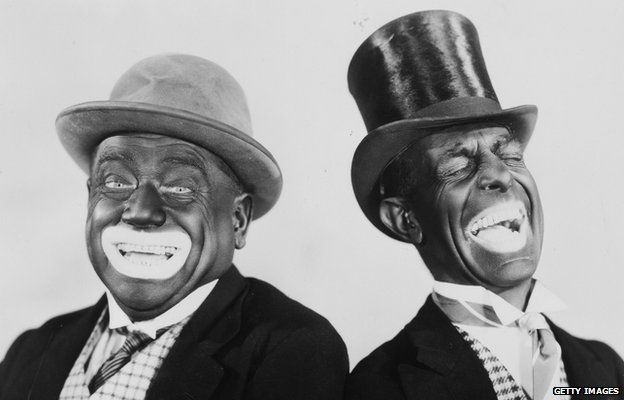
"How would you feel if someone were to wear Blackface to a costume party?" and I get the expected answers, something along the line "who would do that?", "That's fucked up!", "Only a racist would do that!" or something along those general lines.
And so I ask them, "Well, why does that offend you?" To which I get some variation of: "That is obvious, you don't do that, because that is racist behaviour, just like you don't use 'The N Word'".
So, then I ask, "Well what if a kid wears blackface out on Hallowe'en? Is a five year old racist?" Then I get lots of eye-rolls. I am often scoffed at for proposing such a ridiculous idea because "what parent would let a child dress up that way? Who would encourage that?"
And this is the point I have led them to and I go one step further: "Well is it ok for a child to dress up as an Indian Princess/Indian Warrior?" and this usually gets the answer "Well, why not?"
So, it's ok for someone to dress up in Redface but not Blackface; what is the difference?**
This usually gets the answer, "It is just make believe", " Everyone does it" or my personal favourite, "It's celebrating Native culture". SERIOUSLY?!?!?!?!
We live in a society that was built by the process of colonization--both in Canada and the USA--on the premise of eradicating a culture for the purpose of acquiring the land and its resources. Stereotypes were deliberately perpetuated to ensure that if not a hatred, an ambivalence towards a population was firmly entrenched into mainstream culture.
Consider we have a white dominated society legitimizing mascots, and products that persistently marginalize a population of people that continue to reside in North America. Author Thomas King discusses the idea of Live Indians and Dead Indians. Dead Indians "are the stereotypes and cliches that North America has conjured up out of experience and out of the collective imaginings and fears" (King, 2012, p. 54).

King goes on to describe war bonnets and fringed deerskin as examples for the reader. These examples act as signifiers. These signifiers have in essence created a simulacrum; a false reality that we assume is reality, that we can no longer recognize as false.*** Dead Indians are found at rodeos, PowWows, movies, and television. King refers to Live Indians as those who did not die out. "Live Indians [are] neither needed or wanted. They [are] irrelevant, and as the nineteenth century rolled into the twentieth century, Live Indians were forgotten, safely stored away on reservations and reserves... out of sight, out of mind" (King, 2012, p. 61). And society is completely okay with that.
We know that when settlers first arrived, encounters were positive and harmonious, and yet at some point, as the governments' demands for more land continued, relations turned ugly as the ideals of the government perpetuated the savage. Those ideas persist today.
This past week we saw the new budget in Canada revealed and after the breakdown, and despite promises of the Trudeau government to remove inequities, Live Indigenous students in Canada are still receiving less per student than their non-Indigenous Canadian counterparts. So I have to ask: how could any child feel good about about themselves when they are still worth less because of their ethnicity? That mainstream continues to accept this reality, downplay it, and say "it's ok, at least it is better than it was" is Hegemony at work in today's society.
* Get rid of the concept of the Native American "Warrior" in the war bonnet. This is such a stereotypical image! The "warrior" in traditional Mohawk culture refers to the responsibilities of the men to follow the dictates of the War Chief and protect their community from threats. The War Chief followed the dictates of the Clan Mothers (Cross & Sévigny, 1994). (Yes, the women made the decision as to whether or not the community would go to war, not the War Chief, and not the warriors).
** Interesting to note that as I typed this in the Blog Dashboard, Blackface is a recognized term, however Redface is marked as a typo.
***check out the movie The Matrix; Jean Baudrillard's
Simulacra and Simulation is featured prominently in the opening scenes. Baudrillard's post modern theories figure prominently in the movie.
Works Cited:
Cross, R. and Sévigny, H. (1994).
Lasagna: The man behind the mask. Vancouver, British Columbia. Talonbooks
King, Thomas (2012),
The Inconvenient Indian. Canada. Anchor Canada.

 The comic does not explicitly identify the ethnicity and/or race of the islanders of “Golly-Wolly Island” but seem to still perpetuate gross stereotypes of non-western island peoples. There are plenty of examples of this shown within the comic. First, we can see a form of black-face in how the islanders are stylistically drawn with overly wide and large lips. They seem to take up most of the islanders faces. This is similar to how black-face was used in Minstrel shows. The hair and costume of the islanders is primal, with the use of bones and various piercings as accessories. The islanders are also cannibals, as to add to the already animalistic characteristics they were given, they also seem to be not as smart as Howdy and Dilly, the main characters whose stupidity is the main focus of the comic series.

