Thursday, February 11, 2016

Seth on Pop Culture


Nostalgia is an odd, very peculiar thing. We look back upon the past and romanticize the pictures that we see float through our minds. Yet it is often the case, when we return to the location where those memories occurred, that idyllic locale almost always fails to measure up.
                                                                                                       
Canadian cartoonist Seth, aka Gregory Gallant, is often characterized, much to his annoyance, as a nostalgic. He certainly understands the 'why' he is so labelled but "you realise that the word nostalgia has a real pejorative quality to it. It tends to imply looking back with a certain kind of sickly sweetness" [Q TV interview, October 15, 2009, https://www.youtube.com/watch?v=_m5D9kGmxlk]. However, I think we can safely assume that Seth ascribes to the notion that Mass Culture Media is very much at work in today's society.


                   ( From Its a Good Life if You Don't Weaken, by Seth, 2011, p. 89)                      

When we look at Seth's work through the lens of Mass Culture Theory, there are two characteristics of MCT that stand out in both his artwork and his ideology: 1) Today's Pop Culture artifacts are somehow inferior when compared to the culture, including Pop Culture, of the past, and 2) There is an embedded fear of change with respect to the future that includes the demoralization of society. This melancholia is consistently apparent in both the characters and stories that Seth creates.

In the over-sized Picture Novella George Sprott, 1894-1975, Seth explores the history of the local television industry prior to the deregulation of Cable Television, through the biography of a fictitious local television personality. In Seth's sketchbook The Great Northern Brotherhood of Canadian Comics, Seth the character, treats us to a tour of a fictitious museum that celebrates Canadian Comic Artists--both real and imagined--filled with many anecdotal reminiscences.  However, it is in It's a Good Life if You Don't Weaken (IAGLIYDW), a story which was originally serialised in Palookaville issues 4-9, that Seth's penchant for the past truly shines.


Briefly, in IAGLIYDW, Seth the character, is tracking down an obscure--and fictitious--Canadian gag-cartoonist by the name of Kalo, aka Jack Kalloway, that in effect is an exploration of art and artistic legacy. Throughout the ongoing search to find this elusive Kalo, the character Seth, through the author Seth, treats us to a narrative that seeks to discover the fading past and justifies his own ever-present dissatisfaction with  present day existence. Again, both Seth the character, and Seth the author, dissociate from the ongoing advancement of today's society and in this instance we are privy to Seth's subtle commentary that nostalgia and/or the past is already a construct, rather than a reality.


(From Its a Good Life if You Don't Weaken, by Seth, 2011, p. 43)                 

The documentary Short documentary on Toronto Graphic Novelist, Seth, https://www.youtube.com/watch?v=_Rjy3c2YFZI  recreates a film from an era long ago; the film looks as though it has suffered over time. The soundtrack harkens to the Jazz clubs of the 30's and 40's. This documentary also examines IAGLIYDW and Seth's attraction to the Pop Culture of the past. We visit Seth in his home, and it is clear from his manner of dress (yes he does indeed dress like this all the time) Seth has recreated himself in the image of a man from the 1930's. He addresses how, in his opinion, 'Culture' has "become increasingly cheap and vulgar as years go by. The quality of the Pop Culture that they are selling us is a very shoddy bill of goods that we are just accepting because we are trained to." Much of society then, to Seth's way of thinking, is simply composed of passive consumers and the products available to society lack any true value. This documentary clearly showcases Seth's drawing techniques, his attention to detail, further reinforcing  his position regarding the value contained within today's Pop Culture media.

In another video, taken during Seth's interview with Jian Ghomeshi for CBC Radio's program Q (feel free to skip to the 6 minute mark) https://www.youtube.com/watch?v=_m5D9kGmxlk, Seth discusses his work, describing it "is about people going over their lives. I don't think it is about longing for a golden age" ... "I make it a point to really clearly show that I am confused, that I don't know what I really think about this time period"... "but not seeing it as some sort of, you know, beautiful golden age".  Seth concludes the interview stating that he does think there has been a cultural decline that depresses him.

Seth perpetuates this construct of the past in his attempts to create an artistic alternative to our present day now (Hoffman, E. & Grace, D., 2015, p. 219). Reclaiming the aesthetics and ideas from the past would, according to Seth, improve our present day existence (Hoffman, E. & Grace, D., 2015, p. 219). Seth believes that this utopian alternative present day, were he to create it "would be something incorporating favourite elements from the past --aesthetics from the past, ideas form the past" (Hoffman, E. & Grace, D., 2015, p. 219).  However, Seth himself contradicts his own ideology, through his creativity, the clean lines in his artistry, his choice of presentation: paper, book size, and packaging; there is no present day decay in quality nor does Seth produce a "shoddy bill of goods" with his comic material. The following that consumes Seth's Graphic Novels quite obviously consciously chooses to purchase his product rather than a substandard alternative. Seth himself, in a very meta way, is motivated by what he perceives as lacking in today's society in actuality provides consumers of his media with superior consumer goods, outperforming that which was available in the very era that  he himself seeks to immortalize. Seth, through his artistry, passionately applying his knowledge of the past, in concert with the materials and resources we have in the the present day publishing houses is in effect creating his own "utopian" Pop Culture media.

Works Cited:

Hoffman, Eric and Grace, Dominick, eds. Seth Conversations. USA: University Press of Mississippi, 2015. Print.


Tuesday, February 9, 2016

Module 4: The Culture of Overconsumption

Walmart and The Culture of Overconsumption
 This article discusses the mass culture theory that states mass produced products have less value and also the point of buying from stores like Walmart who are mass produced, the products will be less valuable then if you bought your products from Target, Whole Foods, or Crate & Barrel. The article discusses how Walmart grew and the tactics they used. "Cheap prices and overwhelming selection have a powerful effect on consumer behavior" With so many of the products at Walmart being mass produced they can sell them at a lower price compared to the other retailers and make a bigger profit. Yes, Walmart was cheaper than the other leading stores, but the push for low prices led to cheaper goods, which then leads to unhappy customers. The price may be low but the quality is bad which means I'm going to have to keep going back to get the same product over and over. "In many ways, Walmart is the quintessential 20th century American company. It took an industry as old as time — retail — and revolutionized it by thinking critically about its conventions. And it used cutting-edge innovations like information technology to revolutionize supply-chain management." I thought this quote was great because it explained how Walmart was an ideal "American company" and this week we focused on the American dream.


http://business.time.com/2012/07/02/ten-ways-walmart-changed-the-world/slide/the-culture-of-overconsumption/

Monday, February 8, 2016

Module 4 Example: Bennett on Today's Music

Prompt 

Find an article, podcast, or video on the web that critiques some element of popular culture through a mass culture theory approach (Note: The piece does not have to directly say "mass culture theory" but should clearly invoke the ideas of mass culture theory). It should have been published within the last 5-10 years.

  1. Provide a brief synopsis of the piece and the link  (1 paragraph)
  2. Identify how the article is making a mass-culture theory argument  (1 paragraph)
  3. Then provide a counter-argument that identifies some of its flaws--especially those that are relevant with the Problems of Mass Culture Theory video  (1 paragraph).

Relevant Tags:  mass culture theory, [name of popular culture being explored]

Example:  Bennett on Today's Music

This article is a partial interview with the famous singer, Tony Bennett.  In it, Bennett says that modern music has gone down the drain in that they don't produce "quality" music.  He believes that the music industry is just pumping out music geared towards youth and is solely focused on making money.  He also believes that the general audience is largely "ignorant."  


All of these comments represent the mass-culture theory approach in that somehow the capital focused companies are producing lots of irrelevant music.  They are not investing time and money to produce real music (supposedly like what Bennett himself produces).  Ultimately, Bennett is arguing that the public has simple and unsophisticated tastes that the companies are capitalizing on.  

Of course, this line of thought doesn't really consider how people who listen to modern music appreciate or make sense of it nor does it consider what is authentic about Bennett's music that is somehow inauthentic about modern music.  How does he know what "quality" is or means?  After all, he is not the sole musician and there is much variation among musicians in his time and since.  The only difference is that some of his music has withstood the test of time, but he would have been also labeled "popular" in his time and seen the same criticisms that he now places upon today's musicians.  He relies on elite taste rather than fully exploring individual artists and music and exploring how fans actually experience such music.

Sunday, February 7, 2016

The impact of a female heroine in the video game industry

It was the most anticipated evolution in game play when Lara Croft's Tomb Raider arrived on Playstation between 1996 and 1998.  Video games primary audience was geared for male players so 
it was very important for Tomb Raider, with a female lead character, to exceed all success potential.

Lara became a modern day hero with her new movements in Tomb Raider as she lead the video game industry into a new era of game play with her ability to maneuver like no other first person game prior to her arrival.  Lara was a pioneer, a rebel, a rough rider...she had outlaw qualities as well as upstanding role model characteristics when she got her way.

Lara had a home in the game but her home was her training course to prep the gamer and their controller with never before combination of moves.  The motions Lara introduced was running jumping and grabbing edges; she had the ability to hang from the edge and 'shimmy' left or right and upon command and learning how not to fall, you could make her pull herself up onto the rock or whatever she may be climbing.  These motions were unheard of, as well as pulling guns out of your holster while running, jumping and aiming at your opponent and so much more.

Lara was truly a famed adventurer and she didn't have good or bad side as she served her needs to raid tombs and get treasures at her own, and at times others expense.  She was a loner, a ranger, a wanderer and possessed absolutely no fear of the uncivilized frontiers and territories she explored and conquered.

As Lance Eaton mentions in the assigned lecture,

"We often see the cowboy in certain lights or there is certain things he is suppose to do.  He is often a man who brings order and that is often order to uncivilized places.  The cowboy is often out in the west in a place that has no rules and he is there to bring some order.  It doesn't mean he is there to bring laws; it doesn't mean he is there to bring government but he is there bring order to an uncivilized place.  But he is often a man that escapes order rather gets away from civilization.  So a cowboy straddles this line between civilized  and uncivilized." (L Eaton, The Cowboy and Western in Popular Culture).  

Lara was designed to be a cowboy heroine for the video game industry, gamers, for the introduction of new game play, as well as a beautiful never before seen type of new frontier, in the depths of tombs.  Tomb Raider and Lara Croft paved the way for the development of video games overall.  Tom Clancy's Splinter Cell and Red Dead soon followed suit and developed similar fashion game play.  Lara Croft's legacy is still developed today with new installments consistently premiering and still just as anxiously awaited by fans old and new thrill seekers.

Dean Winchester- Modern Cowboy?

Throughout this week's assignments I couldn't stop trying to think of a perfect example of a modern cowboy, and my mind kept coming back to the first thought I had, Dean Winchester from the long-running television show from the CW network, Supernatural. Before I make my case, lets look at the definition of a cowboy that was provided in the mini-lecture:
1) Idealized Man/Romantic Notion
2) A man who brings order (to uncivilized places)
3) A man who escapes order (gets away from civilization)
And the types of cowboys mentioned are:
-Adventure seekers and Explorers
-Visitors and Wanderers

For those that have never heard of Supernatural, it is (at its base) a show about two brothers, Sam and Dean, that drive around the country and hunt monsters. To avoid making this blog post an explanation about the 11 season history of the show and talk about why everyone should watch it, I am going to leave the show at that description for now. Because I want to tell you all about Dean Winchester.

Dean Winchester has lived his whole life virtually off the grid and has drove around the country with his father since he was a child hunting monsters. His brother, Sam, doesn't fit the definition of a cowboy as much because he always craved normalcy, and went off to college as soon as he had the chance. Dean always accepted the way his life was and didn't see anything wrong with it. 

A Man Who Brings Order (to uncivilized places)
Dean's version of an uncivilized place could be found in someone's living room- he hunts monsters that intend on (and usually succeed in) hurting/killing people. Sometimes they are ghosts, sometimes demons, and sometimes a type of monster that only exists in storybooks. He is a protector of all humans, and he doesn't even get the recognition most of the time. 

A Man Who Escapes Order (gets away from civilization)
Dean has always lived off the grid, pretty much jumping between living in his car and living in run down motels in whatever town they find themselves hunting in all over the country. Dean doesn't have friends, just family and other hunters that he occasionally would communicate with, and he was basically always alone; hunting could be considered a lonely job, being the only ones that know the truth about whats out there. They live by their own rules, and often break the law in order to save people. 

So is he a cowboy? 
I absolutely consider him a cowboy! Particularly in the first few seasons, as things get rather complicated as the show goes on (as it is wont to do). Ignoring the technical definition, even just looking at him you would think of him as a cowboy. He is a rugged man from down south (Kansas) that even travels the country on his trusty steed: a 1967 Chevy Impala.
All he is missing is the hat, and he would be a full-blown cowboy. (which, incidentally, they played off of in an episode called "Frontierland" in season 6)


Rick Grimes; Modern Cowboy


As we learned this week in Module 3 there are still ‘cowboys’ in our modern day popular culture. Although our “Cowboys” may not be your typical “standard role of a cowboy in the wild wild west to steer the cows in the right direction,” they are all around us in movies, television, and books. A modern day cowboy could have some traits of being a rough edged man, goes against the law, and follows his own sense of a code. 

A cowboy that is in one of our popular culture Television series that isn’t a straightforward cowboy in my eyes is Rick Grimes from the well know AMC television series The Walking Dead. Rick Grimes is the epitome of a modern day Cowboy. He embodies the traits of a rough edged man after all he has dealt with because of the zombie apocalypse. He follows a very strict code in the way he deals with life in every single episode. The other characters in the series also look to Grimes as a leader and he is highly respected by almost everyone. Before the zombies, Rick was a sheriff Deputy, which also connects him as being a modern day cowboy in a sense. A little side note, when the series began Rick was known for his beige and brown police uniform, which he paired with a brown cowboy hat. Later his son Carl, in the rest of the series, wears the cowboy hat. The irony of the cowboy hat is amazing to this week’s module and raw topic of a modern day cowboy. Zombies, Modern Cowboys, and Popular Culture are three topics that are truly a great mix. This show is one of my favorites and I encourage everyone to watch it! 

Saturday, February 6, 2016

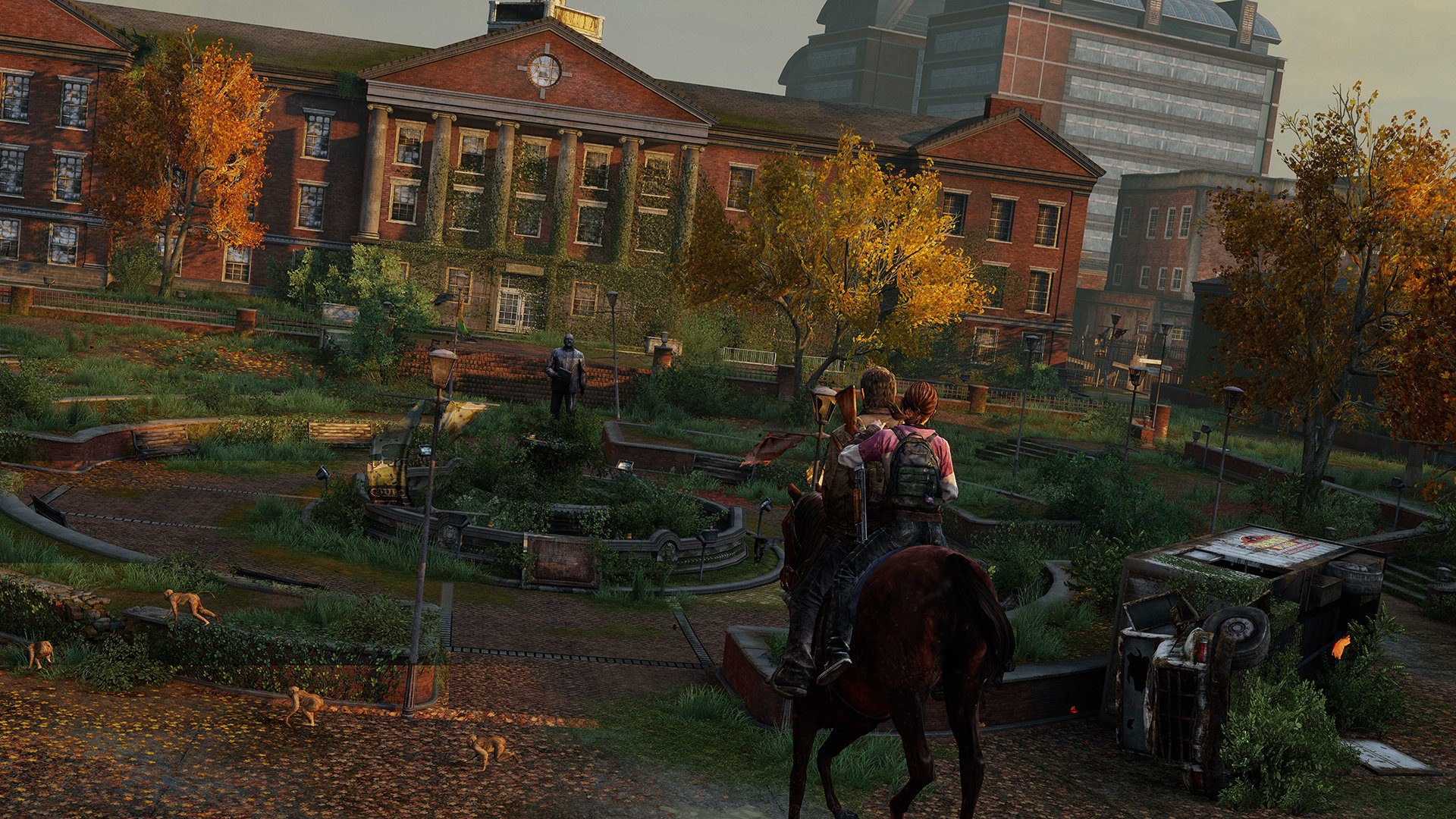
The Last of Us: A True Modern Western

As I mentioned in my first blog post, I'm an avid gamer. You probably also noticed that in the bottom of said post, I had said that my second favorite game of all time is Naughty Dog's The Last of Us. This game is simply incredible in all senses of the world (and if you have a PS4 or PS3, you MUST play it), but especially because of it's deep narrative. The story starts with a man named Joel, a single father living at home with his daughter, when all of a sudden, a fungal infection starts spreading rapidly across the US (it's revealed to be a humanized form of the cordyceps fungus). Like a traditional zombie story, if you are bitten, you are infected. Joel is forced to transport a girl named Ellie, who is apparently immune to the fungus, and Joel must take her across most of the US, from Boston to Utah, where a group is trying to find a cure for this infection.
Image Source

Joel is a perfect example of a modern cowboy, and The Last of Us is a perfect example of a modern western. Firstly, they are, in fact, moving west throughout the entirety of the game. They didn't even try to blur the lines on this one, Joel's goal is to successfully move west throughout the US to reach a hospital in Salt Lake City, UT. Like other typical cowboys, Joel is a masculine white male. He often acts tough and hardened, and has to endure a lot of brutality throughout his life, especially in the time the game takes place. By bringing Ellie to Utah, he is trying to bring order to the lawless land of infected that the US has become. If a cure can be found, order can then be restored in the country, since the infected will all theoretically be either cured or killed.

Traveling most of this journey on his own, it can be safely assumed that Joel is quite self-sufficient, often even crafting weapons and other items along his trek, such as first aid kits bandage himself. Unsurprisingly, the environment surrounding him is quite hostile, with essentially everything trying to kill him and Ellie. Life has been reduced to shambles compared to what it once was, and the country is trying to sort life out once more and regain balance.
Image Source

The story fits essentially every trope you've come to know from the Western genre, yet manages to modernize it with great success. Joel is every bit a cowboy as any other one that's ever existed, and the story is a Western through and through, without a single doubt in my mind. If you get the chance, please check out this fantastic game, you won't regret it. Here's a trailer to leave you with a taste of what the game is all about (WARNING: GRAPHIC).

Thursday, February 4, 2016

The Inuit Demi-Goddess Nelvana of the Northern Lights - a Cowgirl?

Nelvana of the Northern Lights, a comic book created and drawn by Canadian artist Adrian Dingle in 1941, adheres to many of the tropes contained within the cowboy genre but fundamentally the character Nelvana subverts many of the traditional characteristics of the Cowboy.

As I mentioned in a previous blog entry, Nelvana was written during the Second World War when Canada could not obtain comic books from the United States due to the War Exchange Conservation Act.  This unique heroine Nelvana--who predates Marston's WonderWoman--was a demigod born of a mortal mother and an unseen Inuit God/father by the name of Koliak. However, she was represented as the familiar archetypal white bombshell beauty, modeled off of Hedy Lemar, in lieu of the more exotic and foreign Inuit female. Additionally, Nelvana had her own super-powers, and was the rescuer of her people; the Eskimos (Inuit).

Nelvana, the feminine protagonist, certainly does not fit many of the traditional cowBOY characteristics but as you will see Nelvana of the Northern Lights--at least in the earlier story-lines--fits the western genre. The first multi-episodic story arcs were set in the Canadian Arctic. Nelvana is summoned by her people, a politically matrilineal culture, to protect them from the external threat at the hands of the evil Kablunets.* The Kablunets were attacking the Canadian North for its resources in an effort to win the war.  In one episode we see the Kablunets hunting all of the whales to destroy a food source for the Northern Canadians and to obtain an alternative form of fuel, and in another indenturing the "Eskimos", forcing them to mine an ore of strange powers.** In all of the early stories, Nelvana most definitely protects her people (the Inuit/Eskimos) from an outside threat, but rather than gunslinging skills, she relies upon her near omnipotent superpowers

What is interesting, particularly given the era this was written (1940's) , Dingle paid particular attention to the process of colonization and in doing so, he subverted the Cowboy/Indian motif. In Nelvana, the threat is provided by the warring non-Indigenous foreigners exploiting the unknown lands, rather than the traditional warring "Indians" threatening the settlers' new homesteads, whilst the hero--the cow"boy" as a girl--and her Inuit people are the "good guys" protecting themselves from the foreign threat. Dingle slyly places us, the readers, in the position of an as yet unconquered people who are fighting back against the invading antagonists/colonizers, whilst bringing the thrill of World War II to the shores of Canada. Additionally, by placing the threat in the Canadian Arctic, Dingle creates a jonbar point and asks the question "What if the War came to Canada?" (keep in mind, the war never actually touched Canadian soil). Readers experienced the thrill of this alternative possibility from a safe and still "foreign" distance, and from the colonizer's perspective, even though Canadians were at risk, it was never "real" Canadians at risk due to their Indigeneity, and thus not "quite" as threatening to Dingle's intended audience. 


     (Page 4, Panel 4 of Death Stalks the Arctic)                     


However in choosing to use an Inuit Demi-Goddess, Dingle created a challenge for himself; very few Canadians knew much if anything about the Inuit culture. In order to rectify this Nelvana is at times a didactic reader of sorts, providing an introduction to how the Inuit lived, including nominal translations of Inuit words.


(Page 2 of Death Stalks the Arctic)                

Dingle incorporated many attributes of the Western in his war-time anti-Western. He uses the Arctic for the setting; a barren, largely uninhabited, and by nature of the extreme climate, threatening terrain for the protagonist and her people. Very few Canadians have ever experienced this landscape, even today, let alone in the 1940's, despite being "Canadian". Due to its remoteness, Dingle created a romantic foreign setting also typical to the western. He capitalized on the public's knowledge of the war to both criticise the Germans and the German ideology that threatened our real daily lives, and to drive his story of the Kablunets*** threatening the way of life for the Inuit. In order to make Nelvana yet more relatable to his readers, Dingle re-envisioned the popular Canadian built  DeHavilland Mosquito--a plywood bomber--with the "Plastex Dragon-flies". 


                                                                      (Page 5, Panel 6 of Battle of the Arctic) 
 
Throughout  the short lived run of Nelvana, Dingle penned a strong, independent, and appealing character--with super-powers--who fought, and defeated, a recognizable enemy that threatened our daily lives. Looking at Nelvana today, we are transported back in time, and can read Nelvana in the same romantic light as we do the traditional Cowboy Western, albeit with a unique... Canadian twist. 
 
*Germans and/or Whites/Non-Indigenous people depending upon where in the series you happen to be, there is some confusion as to the usage; variation on the spelling of Qallunaat that means "white people"

**Presumably Plutonium 

***This is where the intended meaning of Kablunet gets blurry. Was Dingle referring to the Germans threatening Canadians, or was Dingle taking a stand on colonialism and the White threat to Indigenous livelihoods?

Works Cited:
Dingle, Adrian, Nelvana of the Northern Lights. Nicholson, Hope (Ed.) & Richey, Rachel (Ed.). Canada, IDW Publishing. 2014. Print.
 

Tuesday, February 2, 2016

Western Themes in Mad Max: Fury Road


The first film with a western narrative that came mind was one of the best, in my opinion, to come out last year, Mad Max: Fury Road. Set in a post apocalyptic world, Mad Max tells the story of Max, an outsider and loner, as well as a group of very strong women, who escape captivity from an evil leader of a corrupt society and his "war boys". The movie then becomes an extended chase scene (with amazing cinematography). Underlying this action is the group’s desire to free this society and give back control of its resources, most importantly water, to its people. 


I think this movie has many western themes and motifs. Replacing the American frontier is a post apocalyptic world. Its desolate landscape conjures up images of the American southwest. Water is scarce and there’s a battle for control of limited resources. This, I think mirrors the cowboy in the American west securing its resources and land. Through this battle Max and the women attempt to bring order to the constant chaos of an uncivilized place. He and the society he finds himself in are under threat from corrupt and hostile forces. Max’s character has all the elements of a cowboy. He’s white, self-reliant, strong, stoic and very independent. He’s also at heart a moral character. At one point he wants to set out into the landscape on his own. In the end, however, he decides to protect those in danger and accompany the group of women in order to follow through with their plan to bring order to what’s left of society. As Jennifer Moskowitz point’s out in The Cultural Myth of the Cowboy, or, How the West Was Won the myth of the cowboy began as a need to pull together a fractured nation. The world in which Mad Max takes place is also fractured and chaotic. Its in need of a figure around which a community can coalesce. One of those figures is Max.
Photo: http://i.kinja-img.com/gawker-media/image/upload/bs0a2p6jyovlotmmwlre.jpg

Monday, February 1, 2016

Module 3 Example: The Cowboy of Mars

PROMPT
Explore and discuss a cowboy or Western motif in a narrative (film, TV series, novel, comic, video game, etc) that isn't a straightforward cowboy or Western.  In your post, you should
  • Briefly explain the narrative (1-2 sentences).
  • Discuss how a character is a cowboy and/or how the narrative fits the Western genre.
  • Identify specific aspects of the narrative that connect with the ideas in the video on The Cowboy and the Western in Popular Culture.
Relevant Tags:  Cowboys, western, 

Example:  The Cowboy of Mars

As I mentioned in the video, cowboys and westerns do not have to take place in the West or in the past.  They can take place in the future and The Martian is a good example of that.  In this movie (adapted from a novel), the main character, Mark Watney finds himself unexpectedly stranded on Mars when his crew takes off without him.  Stuck in a hostile environment with very little food and shelter, he must find ingenious ways to survive long enough for a rescue team to capture him.  

'The Martian' Movie Poster -- Udvar-Hazy Center Chantilly (VA) 2015


Initially, you might not think Watney (played by Matt Damon) to be your typical cowboy.  After all, he is not saving townfolk and he is not fighting "bad guys." However, let's look at some of the things that character does.  First, he is existing in a place where life (for humans) is still being worked out and Mars is largely a hostile world--he cannot survive without his spacesuit.  Add to this the many long shots of sand and rocks and it feels very much like "the west" but with a red tinge.  As for Wattney, he is white, male, and certainly masculine (in earlier parts of the film, we see a very buffed Damon--mostly to contrast with the second half of the film, but it's made clear--he's quite strong and a very capable man).  Now in the film, he doesn't deal with foreign threats per se, but as the botanist, he is the only person among the crew that could make life or sustain life in the long run, so in that capacity, he is there to tame and bring order to the planet.  Though he is ultimately in need of rescue, he needs to be the fully idealized man to survive on the planet long enough to hitch a ride from his cremates and his ability to survive against the hostile Mars renders him a cowboy.